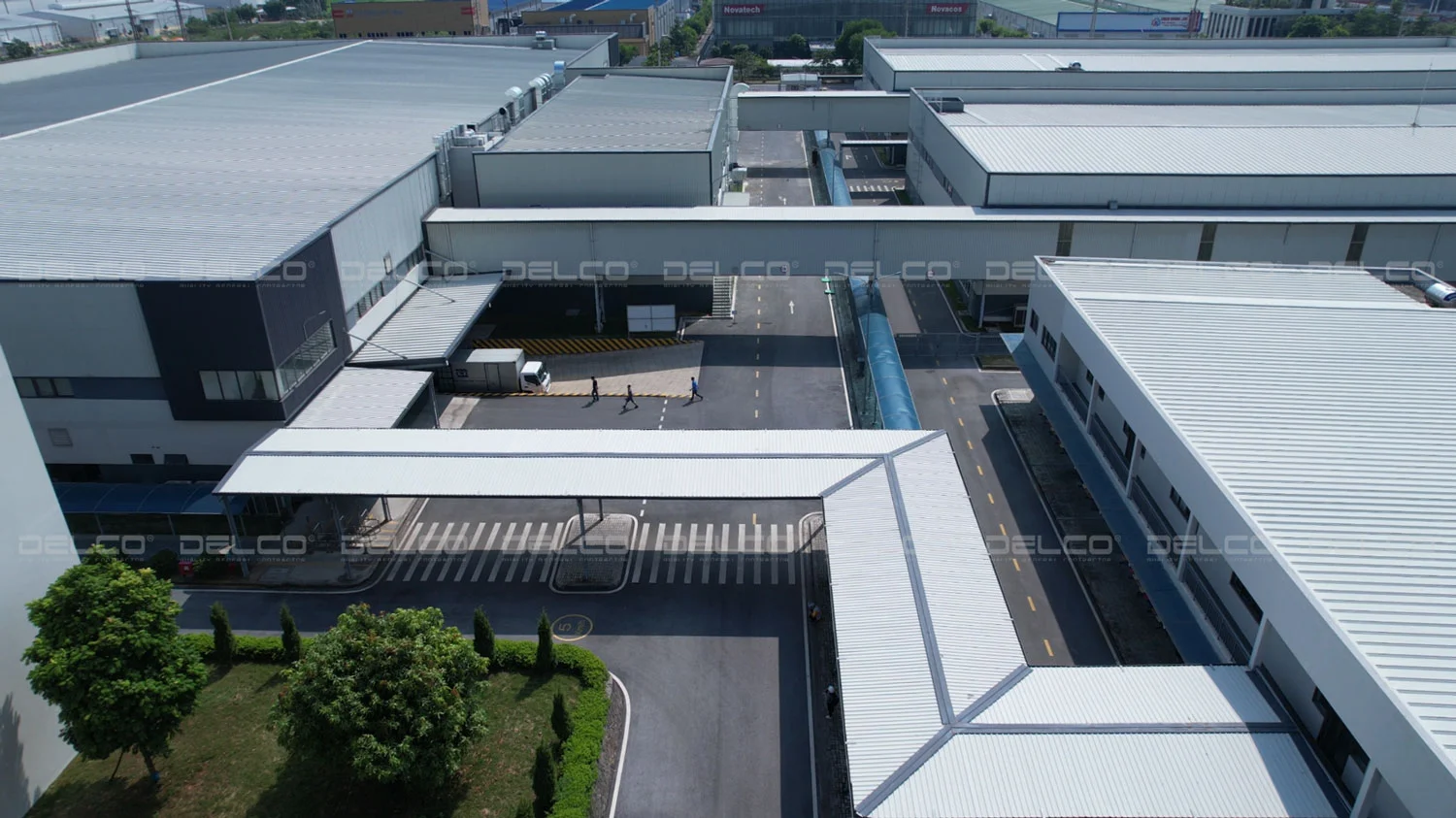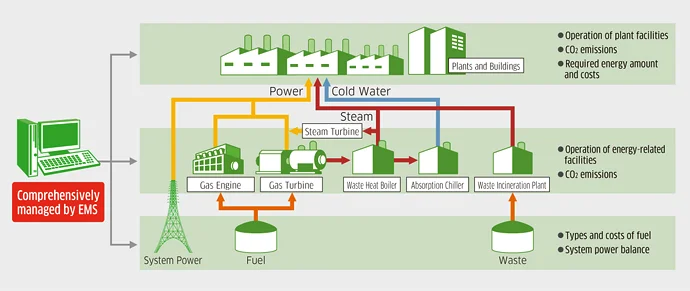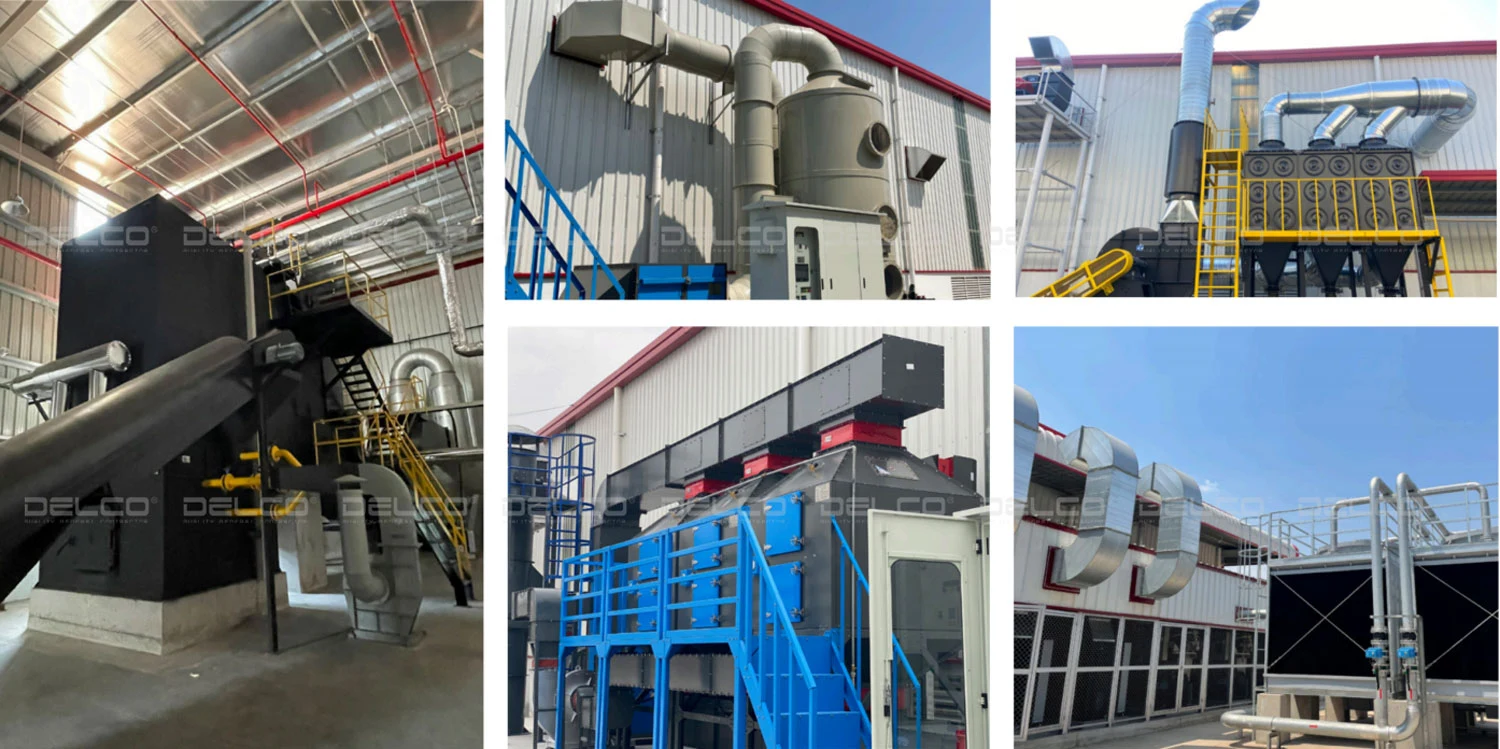


Factory construction consultancy in 2025 not only covers design orientation, permitting support, and technical advice, but also serves as a strategic partnership that helps investors – especially foreign-invested companies – optimize planning, comply with international standards (GMP, ESG, ISO), and manage risks across the entire project lifecycle, from design to operation.
1. Scope – What is included in factory construction consultancy services?
Industrial factory construction consultancy covers many levels — from master-planning surveys to detailed technical design and construction management. A medium-sized FDI project in Vietnam typically includes the following main work packages:
1.1 Master planning
This foundational step shapes the whole development, helping the investor visualize the project, determine investment scale and prepare for detailed design.
Collect information on production processes, industry specifics, technical requirements and the company’s expansion direction.
Analyze topography, traffic, technical infrastructure, and the feasibility of electrical/water connections and wastewater treatment.
Propose several master-planning options and production-line layout(s) for the investor to choose from.
Produce a preliminary investment cost estimate and balance construction costs with long-term operating costs.
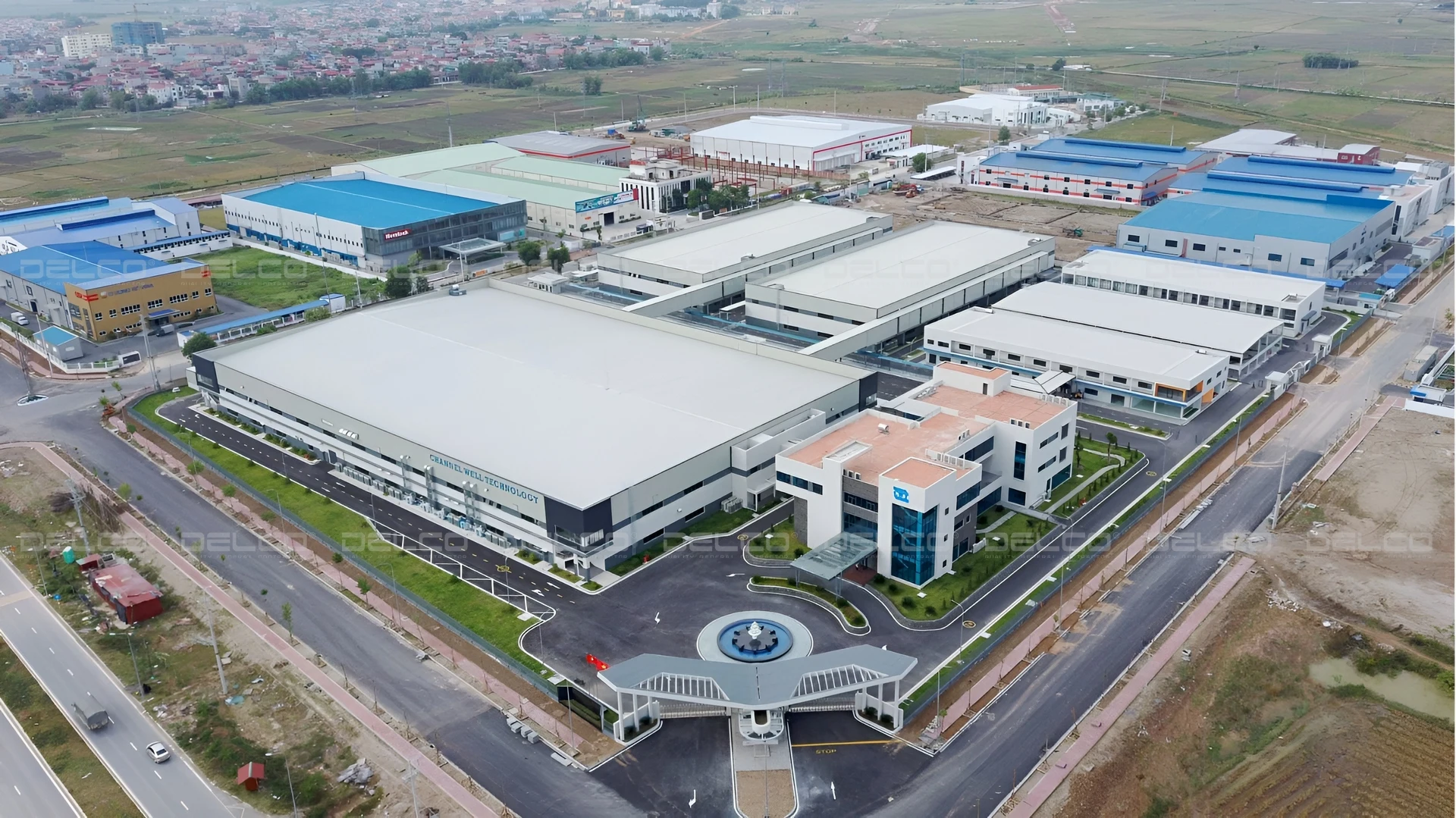
Overall view of the Power Plus Technology plant project where Delco acted as design-build main contractor (construction + M.E.P).
1.2. Design phase
In the design phase the Design & Build contractor takes responsibility for the following design tasks:
Design of the overall functional site plan, architectural solutions, structural solutions and mechanical, electrical and plumbing systems (MEP). Propose materials and equipment for the entire project.
Prepare technical construction drawings and documentation for construction permits (GPXD) and fire safety approvals (PCCC), ensuring the project complies with the Environmental Protection Law 2021, Fire Safety Standards QCVN 06:2021/BXD and Urban Planning & Construction Standards QCVN 01:2021/BXD.
1.2. Mechanical, electrical & plumbing (MEP) systems
MEP systems in an industrial factory include five main groups:
HVAC (Heating, Ventilation & Air Conditioning): designed to national/international technical standards to ensure air circulation, control of temperature and humidity appropriate to each production area; optimise airflow and energy consumption.
P&S (Water supply & drainage): ensure stable water supply, effective drainage, wastewater treatment compliant with environmental regulations and suitable for production-line layout.
Electrical system: designed to meet NFPA 70 and ISO 50001 requirements, including power distribution, lighting, control panels, UPS and energy-saving systems; prioritise equipment that can be automatically controlled according to actual load.
Fire protection system: comply with QCVN 06:2022/BXD and combine international active fire safety solutions; consultancy should coordinate early with approval authorities to shorten permit lead times.
Smart factory systems: integrate MEP systems on a central control platform (BMS/EMS) to enable real-time monitoring and optimisation of energy, the working environment and operational safety.
Overall, design is carried out with a “smart economical design” approach — maintaining technical standards, safety and functionality while removing unnecessary detail to optimise capital expenditure, operating costs and future expandability.
2. How do international standards (GMP, ESG, ISO) affect factory design and project management?
FDI flows typically demand international standards such as GMP, ESG and ISO as credible proof of a manufacturer’s capabilities. However, in recent years — with order declines and rising interest rates — many investors have shifted strategy: they keep essential quality standards but focus more on feasibility, financial flexibility and phased expandability.
2.1. GMP — mandatory standards for food, pharmaceuticals and medical sectors
GMP (Good Manufacturing Practice) governs workshop architecture, finishing materials, flow patterns and air cleanliness.
Applied in pharmaceuticals, food, cosmetics and medical sectors.
Directly impacts spatial layout, personnel/material flow, wall/floor/ceiling finishes and HVAC systems (positive pressure, HEPA filtration). Investment should be phased according to production stages.
Consultants must be familiar with GMP-WHO or GMP-EU and work with operations experts to ensure one-way production flow that prevents cross-contamination.
When dividing the site into “modules” (independent clean rooms), the consultant should help the investor determine the appropriate cleanliness level for each area. Uniform, simultaneous investment across all modules may cause waste because each module needs separate filtration, pressure control and cleanliness management, raising initial capital costs.
2.2. ESG (Environment – Social – Governance)
ESG is no longer a new concept in the manufacturing sector. Although not yet mandatory, ESG criteria are increasingly used by investors—especially exporters to the EU and US—to evaluate partners and suppliers.
The “E — Environment” criteria focus on energy savings, emission reduction and use of eco-friendly materials. Utilising natural light and ventilation is only a small part of the “E” strategy; modern projects also require optimised HVAC, lighting and intelligent energy-monitoring systems to reduce operating costs.
The “S — Social” criteria concern working conditions, occupational safety and worker amenities.
The “G — Governance” criteria relate to transparency, operational procedures and internal control.
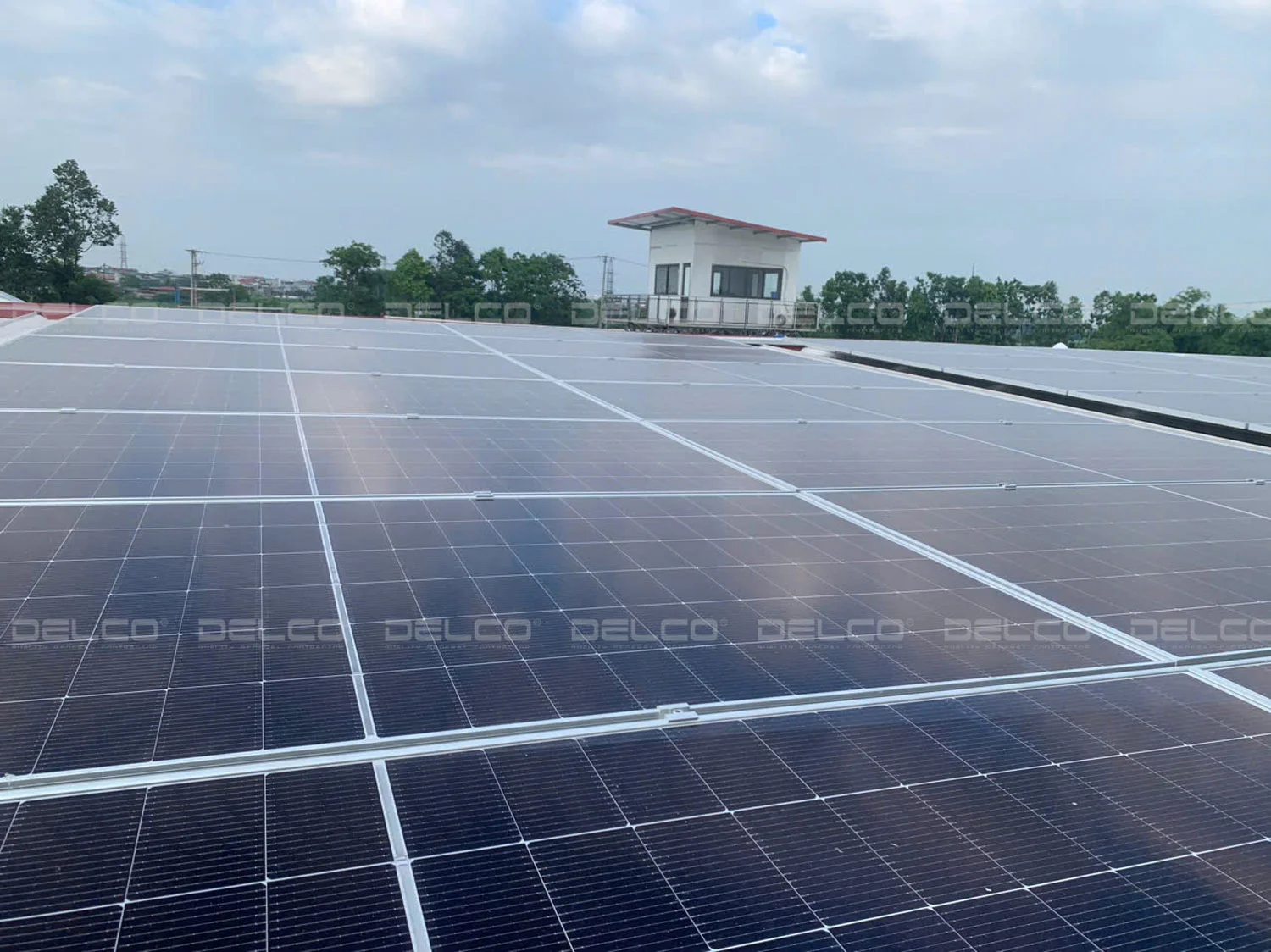
Automatic lighting and rooftop solar panels applied by Delco at the Delco Farm — Bac Ninh project.
2.3. ISO standards (ISO 9001, 14001, 45001, 50001, ISO 22000)
Consultants must prioritise which standards should be implemented first and which can follow, balancing compliance with realistic investment costs.
| Standard | Scope / Main objective | Impact on design & construction | Suitable projects | Mandatory / priority level |
| ISO 9001 | ISO 9001 Quality management | Ensure a consistent quality management system across all stages: design – procurement – construction – handover. | – Standardize design approval, inspection and acceptance processes. – Manage drawing and material revisions. – Control acceptance records and supplier management. | All project types, especially manufacturing plants. |
| ISO 14001 Environmental management | Manage environmental impacts of construction and operation. | – Environmental impact assessment. – Waste, wastewater and emission management. – Selection of eco-friendly materials. – Design for energy & resource efficiency. | Large-scale projects or those inside industrial parks. | Important; should be implemented alongside ISO 9001. |
| ISO 45001 Occupational health & safety | Ensure worker safety throughout construction & operation. | – Safe construction procedures. – Personnel training and PPE provision. – Emergency response, fire safety, equipment safety. | All construction projects, especially high-risk works. | Not mandatory but recommended for high-standard factories. |
| ISO 50001 Energy management | Monitor and optimize energy consumption. | – Design energy-efficient MEP. – Install energy metering systems. – Consumption analysis & improvement plans. | Energy-intensive plants, automated production lines. | Should be implemented after ISO 9001 & 14001. |
| ISO 22000 Food safety | Ensure hygiene and food safety across the production chain. | – Design of clean rooms and personnel/material flows. – Anti-cross-contamination, easy-to-clean materials. – MEP systems to ensure correct temperature & humidity. | Food processing, beverage and food packaging factories. | Mandatory only for the food sector. |
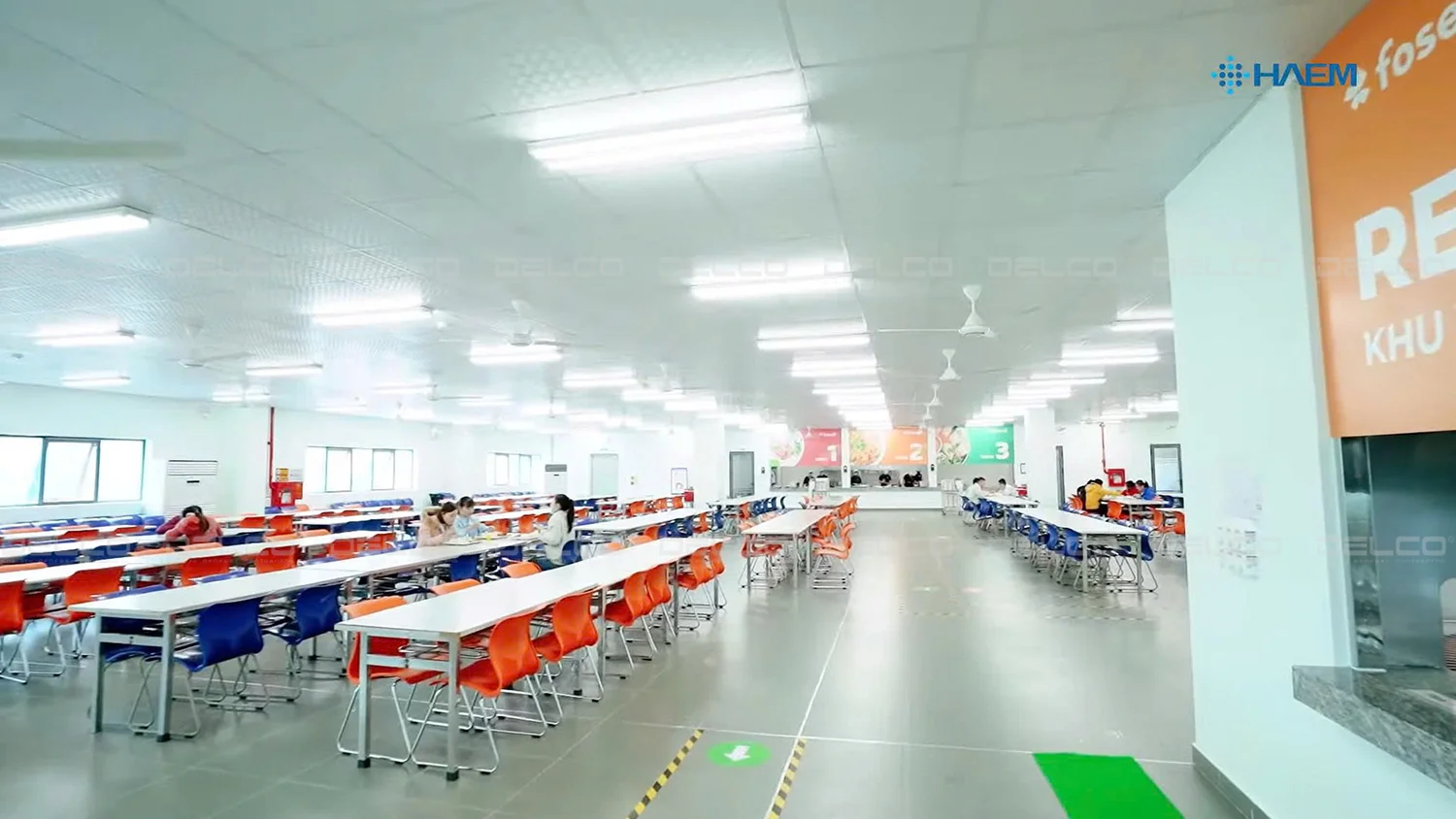
Haem Vina project where DELCO served as Design & Build main contractor, applying ISO 45001 safety standards during construction.
⪢ Key international standards in factory fit-out
3. How does coordination between the investor and main contractor work?
Coordination among investor, consultant and contractor is the key determinant of project effectiveness. The Design & Build full-turnkey model is becoming popular in Vietnam because it shortens schedules and optimizes budgets.
3.1. Survey and advisory phase
- Site survey, legal assessment, analysis of land cost, technical infrastructure and local labour.
- Prepare a preliminary investment cost report, timeline and initial risk analysis to help the investor decide quickly in a volatile market.
3.2. Design – bidding phase
In the Design & Build model, bidding starts from the design phase.
The selected option is developed into the concept/basic design, which becomes the basis for the investor to select the Design & Build contractor.
All design documentation is prepared with a “smart economical design” approach, ensuring technical standards, safety and aesthetics while removing unnecessary details to optimise budget and buildability.
3.3. Construction phase
- The main contractor executes construction against approved drawings, maintains technical diaries and provides weekly supervision reports. This ensures supervision and quality control until handover to the client.
- Use of online progress-management platforms is becoming a standard in FDI projects in Vietnam.
3.4. Acceptance — operation phase
- Consultants coordinate statutory acceptance with authorities (fire safety, construction, environment).
- The main contractor hands over completion documentation, As-built drawings and MEP operation manuals.
- For factories meeting ESG/GMP standards, commissioning and validation are longer processes that typically require participation from international experts.
4. What to note in risk management for FDI construction projects in Vietnam?
4.1. Legal & permitting risks
- Changes in zoning, fire safety procedures or environmental permits can delay schedules.
- Consultants must closely follow local authorities and update new regulations such as Decree no. 15/2021/NĐ-CP and Decree no. 06/2021/NĐ-CP, together with the amended Construction Law 2020.
4.2. Cost & exchange-rate risks
- Price volatility for construction materials like steel, cement and imported items has a major impact.
- Contracts should include price-adjustment clauses and specify payment exchange-rate terms with contractors.
4.3. Technical & schedule risks
- Coordination failures between design, construction and MEP are a principal cause of delays.
- For high-requirement projects such as GMP or clean factories, trial runs, testing and system tuning are extended to ensure stability before official operation.
4.4. Operation & maintenance risks
Long-term factory operation without a proper maintenance plan can lead to significant costs within two to five years. Establishing long-term warranty and maintenance plans from the project’s outset is essential. This reflects the contractor’s design and operational experience and contributes to long-term operational effectiveness.
As one of the consultancies with hands-on experience in many factory projects for European, Korean, Japanese and Taiwanese groups, Delco observes that in the FDI market of 2025 — under dual pressure from cost and order volumes — construction consultancy is not only engineering design but strategic investment planning.
Investing correctly at the consultancy stage is the key for FDI enterprises to safeguard capital, ensure stable operation and be ready to accelerate when the market recovers.
👉 Contact the technical consultancy team to receive a preliminary analysis of the investment roadmap and recommended design standards for your project in Vietnam.